

Edited by Anna Popper
Observed annually on 20 November, the National Day of the Sultanate of Oman is an occasion to celebrate history, achievements, and the spirit of the nation. The holiday also honours the late Sultan Qaboos bin Said Al Said, whose reign from 1970 to 2020 shaped five decades of economic and social progress, transforming Oman into a modern and prosperous state and strengthening national pride.
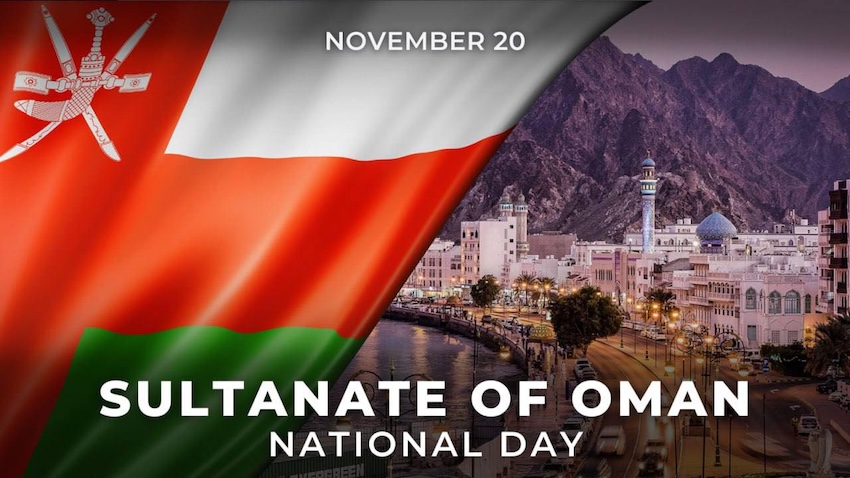


Since ascending the throne on 11 January 2021, His Majesty Sultan Haitham bin Tariq has upheld his predecessor’s legacy, leading Oman to excellence. Launched in 2020, the “Renewed Renaissance” reflects a national vision under the inspirational leadership of His Majesty the Sultan, focusing on modernising governance, diversifying the economy and strengthening social welfare in alignment with Oman Vision 2040.


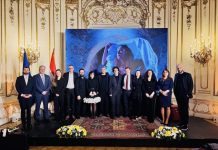
The 55th National Day of the Sultanate of Oman was celebrated on 20 November 2025 in style at the Four Seasons Hotel Gresham Palace in Budapest with a grand diplomatic reception, hosted by His Excellency Malallah bin Mahmood Al Balushi, Ambassador of the Sultanate of Oman to Hungary, and Mrs. Faiza Al Raisi.


The event brought together senior Hungarian officials, ambassadors and members of the diplomatic corps, invitees from the cultural, business and academic circles, as well as Omani nationals living in Hungary. Many attendees wore traditional national attire of their respective countries. The Guest of Honour was Mr. Tamás Vargha, Deputy Minister of Defence and Parliamentary State Secretary.


The program began with the national anthems of Oman and Hungary,


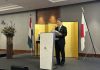
and was followed by the address of Ambassador Malallah bin Mahmood Al Balushi on the occasion of the solemn anniversary:

“Your Excellency Tamás Vargha, Deputy Minister of Defence and State Secretary at the Parliament, Your Excellencies, Ambassadors, Distinguished Guests, Peace be upon you, and God’s mercy and blessings,
it gives us great pleasure to welcome you and to have you join us on the occasion of Oman’s Glorious National Day. This celebration embodies the Sultanate of Oman’s pride in its deep-rooted history, which dates back to the establishment of the Al Bu Sa‘id State on 20 November 1744, when the founding Imam, Ahmad bin Sa‘id Al Bu Sa‘idi, unified the banner of the nation and laid the foundation of the modern Omani state – built upon sovereignty, unity, and dignity.
It is also an occasion to honour the Sultans of Oman who have carried this responsibility with dedication and competence, preserving the unity and prosperity of the country and strengthening its civilizational and humanitarian presence at both regional and international levels. We also celebrate the progress achieved since Oman’s Blessed Renaissance in 1970, the foundations of which were laid by the late Sultan Qaboos bin Said – may Allah bless his soul – and this development continues today under the victorious march led by His Majesty Sultan Haitham bin Tariq – may Allah protect and preserve him – through a renewed vision that balances authenticity and modernization.


The Sultanate of Oman and Hungary maintain good relations based on mutual respect and the principle of non-interference in the internal affairs of other states. In 2020, the Omani–Hungarian Joint Economic and Technical Committee was established in Muscat. The Committee held its first meeting in Budapest in 2023, chaired on the Hungarian side by H.E. Tamás Vargha, Deputy Minister of Defence and Parliamentary State Secretary, and on the Omani side by H.E. Sheikh Khalifa bin Ali Al Harthy, Undersecretary of the Ministry of Foreign Affairs for Political Affairs.

The second meeting took place in Muscat in October 2024, chaired by Undersecretary of the Ministry of Foreign Affairs for Political Affairs. The outcomes were highly fruitful for both countries, and the third meeting is expected to be held in 2026 in Budapest.


During 2025, both countries witnessed high-level visits in various fields, including defence, energy, water resources and the diplomatic academy.
The two countries cooperate in the cultural field by providing scholarships for Omani students under the Stipendium Hungaricum Programme, and scholarships are also offered to Hungarian students to study the Arabic language.
Recently, a grand scale joint production was also realised between the Royal Opera House Muscat and the Hungarian Palace of Arts (MÜPA) under the title “Sindbad: The Omani Sailor”, a stunning new Arabic opera that celebrates Oman’s rich maritime heritage and cultural legacy on the global stage.

The Sultanate of Oman has established a firm diplomatic approach based on positive neutrality, balance, dialogue, and respect for the Charter of the United Nations and international law. In this context, the Sultanate of Oman renews its steadfast position in support of the legitimate rights of the Palestinian people to establish their independent state on the borders of 4 June 1967, with East Jerusalem as its capital, in accordance with international legitimacy resolutions. Oman calls upon the international community to work seriously to achieve the two-state solution as the just and only path to a comprehensive and lasting peace in the Middle East, affirming that anything short of this is merely temporary solution and neither serves the collective interest nor achieves the desired stability.

The Sultanate of Oman continues its efforts to realise Oman Vision 2040, which reflects the State’s ambition to build a diversified economy, a prosperous society, and effective modern institutions. In 2025, Oman made significant progress in economic and financial modernization, including enhancing the efficiency of public spending and raising the sovereign credit rating to investment grade.
In the field of environmental sustainability, Oman is aiming for net-zero carbon emissions by 2050 through ambitious green hydrogen and renewable energy projects.

We are pleased to express our gratitude for the excellent cooperation and generous support received by the Diplomatic Mission of the Sultanate of Oman from the friendly Hungary.
We also extend our sincere thanks and appreciation to First Secretary Omar Al Zadjali, all members of the Mission, and our local staff for their contributions and cooperation in the successful preparation of this event.
Wishing you all continued well-being, Peace be upon you, and God’s mercy and blessings.”
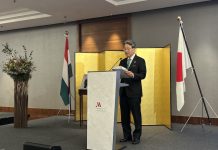
Mr. Tamás Vargha, Deputy Minister of Defence joined the celebrations as Guest of Honour and conveyed warm greetings and sincere congratulations on behalf of the Hungarian Government on the National Day of the Sultanate of Oman.

In his remarks, he recalled that Hungary was the first country in Central and Eastern Europe to open an embassy in Muscat – a clear sign of Hungary’s intention to build a close, reliable, and forward-looking partnership with Oman.
He highlighted the Hungarian–Omani Joint Commission on Economic and Technical Cooperation as a cornerstone of bilateral engagement. Mr. Vargha proudly noted that he had the honour of co-chairing the Commission’s second session in Muscat in October 2024, where both sides reaffirmed and renewed cooperation in priority areas such as energy and renewable energy, investment, trade, and water management. He placed special emphasis on the importance of national sovereignty as a shared value and competitiveness as a shared goal.

Mr. Vargha also drew attention to the strong educational dimension of the relationship. Hungary provides scholarships to 50 Omani students each year through the Stipendium Hungaricum Programme, describing this cooperation as a meaningful long-term investment in prosperity and deeper people-to-people connections.
He concluded by expressing appreciation to everyone – on both sides – who consistently strive to develop Hungarian–Omani relations and translate shared goals into concrete results.
Following this, a young Hungarian woman Ms. Dóra Pethes took the floor and spoke warmly and enthusiastically about the years she spent in Oman, where her parents worked. She recalled this joyful and formative period that shaped her outlook on life. She described Oman as a peaceful, hospitable country with remarkable natural diversity and a long, pristine coastline, and remembered especially its multicultural atmosphere and the genuine kindness of its people. Oman, a place of enduring appeal on the south-eastern edge of the Arabian Peninsula, remains close to her heart, and she will always cherish the memories of this place.


The official proceedings were followed by a lavish reception, where guests were treated to a refined selection of specialties. The tables were laden with a variety of gourmet dishes, blending local and international flavours, including a whole roasted lamb as the centrepiece of the main courses, alongside other carefully prepared dishes that reflected evident culinary mastery. Particular attention was given to the dessert selection, presented with aesthetic finesse. Made from premium dates and complemented by almonds, pistachios and a hint of honey. Dates hold a special place in Arab gastronomy and culture, symbolising hospitality, abundance, and blessings. Central to festive occasions, they are often served in creative, visually attractive forms, and offering them is a gracious gesture of welcome and deep respect for the guests.


Sindbad: The Omani Sailor – A New Arabic Grand Opera in Omani–Hungarian Cultural Partnership 2025
It would be interesting to discover how the idea of creating this opera was first conceived. Hardly any project could better embody the cultural confidence of Oman’s modern renaissance than a new grand opera – one of the highest artistic musical genres – that begins and ends in Oman and carries the country’s maritime and storytelling heritage to the world through the figure of a fascinating hero. This is exactly what Sindbad: The Omani Sailor (also presented as Sindbad’s Journey – The Omani Sailor) has accomplished: a landmark Arabic-language grand opera, realised through an outstanding partnership between the Royal Opera House Muscat (ROHM) and the MÜPA Budapest (Palace of Arts, Hungary).
More than just a performance, this collaboration is a statement that culture is a vessel of memory, pride, and connection. In Muscat, the world premiere did not simply introduce a new work – it demonstrated how Oman’s maritime and cultural heritage can be reimagined on the world stage through a shared artistic language.

A Historic Milestone: An Opera Born from the Sea, the Desert, and Omani Myth
The Royal Opera House Muscat opened its new season in October with the world premiere of Sindbad: The Omani Sailor, described as an authentic “Arab opera”. As the first full-scale opera of its kind, it honours an Arabian theme while using the grandeur and dramatic power of opera to bring a beloved legend to contemporary audiences.


At the heart of the production is a creative transformation: Sindbad is not portrayed merely as a universal mythical sailor, but as a distinctly Omani hero, shaped by the Sultanate’s coastlines, deserts, and mountains, as well as its values and enduring spirit. His journey becomes both a sweeping adventure story and a cultural portrait rooted in Oman’s maritime heritage and its imagination.
This project is a true meeting of artistic excellence across borders:
Libretto: written by acclaimed Omani author Nader Mohamed Salah El Din
Music: composed by Egyptian Maestro Hisham Gabr, who has also conducted the Hungarian Radio Symphony Orchestra


Direction: staged by Csaba Káel, Intendant of MÜPA Budapest (Palace of Arts) and founder of the Bartók Spring International Art Week
Several Hungarian artists played an active role in the birth of the opera, which was realised in collaboration with the Hungarian Radio Symphony Orchestra and the dancers of Győr Ballet. The spectacular sets were designed by Éva Szendrényi and the extraordinary costumes were created by Rita Velich, bringing international vision and theatrical leadership to the production.


Beyond its artistic success, the collaboration between the two institutions carries a philosophy that is reflected in the spirit of the project: transforming differences into harmony, so that each tradition retains its identity while contributing to a shared language of beauty and art.
One of the production’s most striking achievements is its musical architecture: the interweaving of authentic Arabic instruments with Western orchestral music, creating a dialogue brought to life by the Hungarian Radio Symphony Orchestra.
The Royal Opera House Muscat presented Sindbad: The Omani Sailor full of adventures on 3 and 5 October 2025, with a concert by the Hungarian Radio Symphony Orchestra, conducted by Domonkos Héja on 4 October, forming a three-day arc of cultural exchange featuring works by the Hungarian composers Liszt, Bartók, and Kodály.
Sindbad Belongs to Oman: Maritime Heritage as a Living Identity
The choice of Sindbad is no coincidence. Oman’s long history of navigation and shipbuilding makes the legend especially meaningful. The opera – filled with magical places, fantastic creatures, and the power of the sea – captures the true spirit of seafaring: wonder, danger, endurance, and faith. The idea that Sindbad believed he was born in Oman has powerful cultural resonance. His adventures may be legendary, but Oman’s maritime heritage is real.
The Royal Opera House Muscat introduced the triumphant world premiere to two full houses, with audiences captivated by its refined artistry, cultural authenticity, and emotional storytelling. This success belongs to everyone who contributed to the revival of the legend through creativity and collaboration.


The production is set to carry the magical world and feeling of Sindbad to Hungarian audiences as the closing event of the Bartók Spring International Art Week 2026 in Budapest. The message is beautifully simple: Oman’s story travels – and in doing so, it takes others along for the ride.

Source: Embassy of the Sultanate of Oman in Budapest
Photos from the Embassy of the Sultanate of Oman in Budapest, radiomusic.hu and Diplomatic Press Agency